

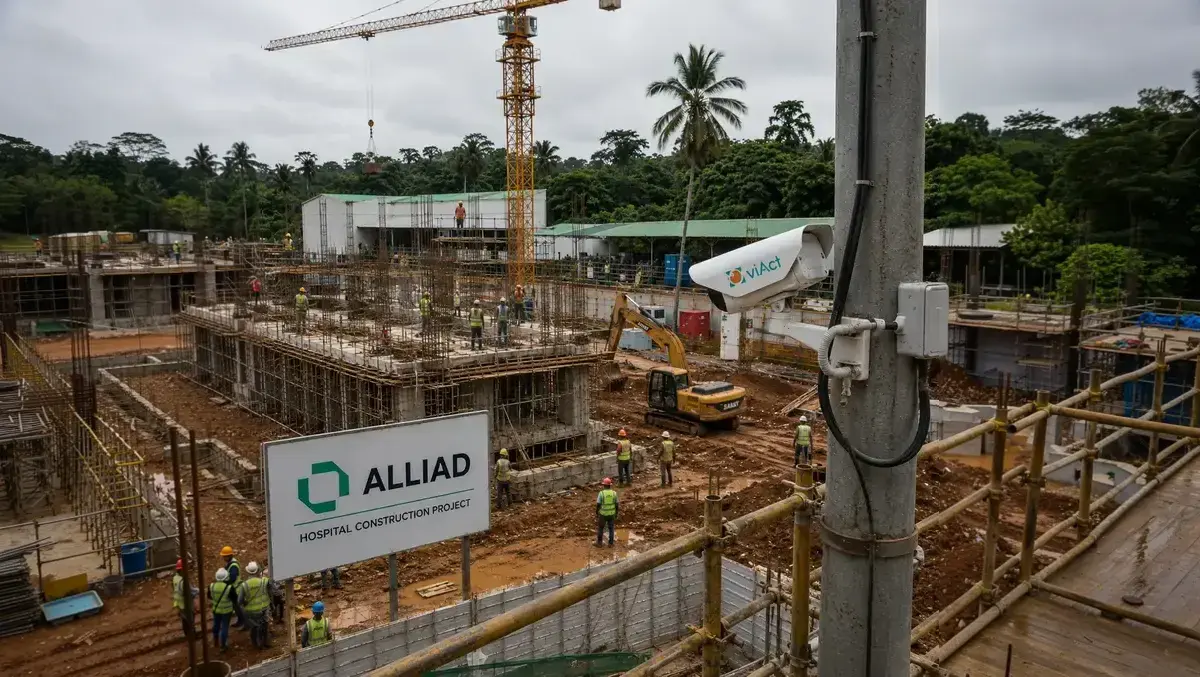
Alliad deploys viAct AI safety monitoring in Côte d'Ivoire
Mon, 24th Aug 2026
Alliad has deployed viAct's video analytics system at a remote healthcare construction site in Côte d'Ivoire, using the project's existing camera network.
Figures released by the companies show a 41.7% reduction in personal protective equipment non-compliances and a 46.3% reduction in danger zone violations within three months. The deployment also introduced continuous monitoring for fire and smoke risks across the site.
Alliad is a construction, engineering and logistics operator focused on emerging markets, particularly in Africa. The Côte d'Ivoire project involves the construction of a major healthcare facility on a large remote site near a forested area with no fixed telecom infrastructure.
A growing workforce and multiple simultaneous activities made oversight more difficult. Alliad wanted better real-time visibility of conditions on the ground so safety teams could respond more quickly to potential breaches.
Rather than install a new camera estate, Alliad used the infrastructure already in place on site. viAct configured its software to monitor three categories of risk: PPE non-compliance, unauthorised access, and fire and smoke hazards.
The PPE module tracked four types of equipment around the clock: safety helmets, safety vests, safety shoes and gloves. The same camera feeds were also used to identify access to restricted or hazardous zones and detect signs of fire risk.
This allowed the project team to expand monitoring without adding more cameras. The system also supported site supervision and reporting through real-time alerts and a central dashboard.
In a statement on the project, Alliad described the installation as a way to strengthen existing safety processes rather than replace them. The deployment was completed on a tight timeline and without additional hardware investment.
"Maintaining visibility across a busy project site is always a challenge. viAct provided an additional layer of real-time monitoring that helped our teams identify potential compliance issues sooner and support our ongoing commitment to high safety standards," said Mounir Ziani, Head of QHSE, Engineering & Construction Division, Alliad.
For Alliad, the project also tested whether existing camera infrastructure could support broader operational oversight in difficult site conditions. The pilot was intended to generate practical information for faster responses on site.
"One of the objectives of this pilot was to make better use of our existing camera infrastructure. Working with viAct allowed us to turn that visibility into more actionable insights, supporting faster responses and informed operational decision-making," said AbdulAziz Al-Enizi, IT Manager, Business Solutions & Projects, Alliad.
Broader use
The companies presented the Côte d'Ivoire deployment as an example of how remote projects are beginning to add software to existing infrastructure rather than rely only on periodic inspection rounds. In this case, the lack of fixed telecom infrastructure added to the operational challenge.
viAct said the Alliad project reflects wider demand from construction operators for continuous site monitoring, particularly where workforce numbers are rising and conditions are changing quickly. It also said the model can be repeated across other sites once the first installation has been validated.
"What we are seeing at Alliad's Côte d'Ivoire project reflects where EHS is heading across the construction sector. Safety teams increasingly need continuous, real-time visibility, not just periodic checks, and they need it without overhauling infrastructure that already works. Deployments like this reflect a broader shift in how AI-powered monitoring is perceived: not as an additional system running alongside existing safety processes, but as a layer built directly on them," said Gary Ng, Co-Founder & CEO, viAct.
viAct also linked the project to a wider effort to move from isolated pilots to repeatable systems across multiple locations. That would allow operators to apply the same approach to similar remote sites without starting each deployment from scratch.
"What excites us about projects like this is the replication potential. A single successful deployment on one remote site gives an operator like Alliad a validated model it can extend across dozens of others, without starting from scratch each time. That's the direction we see EHS technology heading: from isolated pilots to scalable, portfolio-wide standards," said Hugo Cheuk, Co-Founder and COO, viAct.