

Closing the Basis-Risk gap in agricultural insurance
Thu, 26th Nov 2026 (Today)
What if, instead of indemnifying the physical economic loss of the crop harvested, you insure against an event?
Whether the event has occurred is decided by an index crossing a set threshold that triggers a fixed payout. The biggest advantage of this system is that there is no need for manual or on-site inspection by a loss adjuster, which means that the payout can take days instead of months or years.
The 2026 El Niño, now on track to be among the strongest on record, is putting that model to a live test. Weather conditions are diverging sharply across agricultural regions, and the eventual crop response will not always move in step with the signal used to trigger a payout. For parametric products, that gap is where the design challenge begins.
Where the Trigger Meets the Crop
In agricultural parametric insurance, the index only sees the part of crop risk it was built to measure. A weather trigger may record rainfall or temperature, but what happens to the crop also depends on the moisture already available and the stage the crop has reached. The same dry spell or rain event can therefore lead to different outcomes, and crossing the threshold does not guarantee the loss lines up with it.
Southern Brazil shows the problem when excess rain, rather than drought, is the issue. Roughly 80% of Brazil's 2026 wheat crop comes from just two southern states, Rio Grande do Sul and Paraná. Persistent rain through maturity and harvest this spring damaged grain quality in Paraná and slowed the harvest in Rio Grande do Sul. Much of that loss shows up as downgraded wheat rather than lower tonnage, which is a kind of damage a rainfall threshold was never designed to capture.
When the trigger and the eventual crop loss separate, that gap is basis risk. Looking back across previous seasons shows how closely a trigger has followed actual crop outcomes. Crop-specific vegetation measures reduce basis risk by making the index and its trigger track the economic loss more closely.
That design work has to happen before the season. For both parametric and multi-peril crop insurance (MPCI), the terms are locked at binding. A parametric trigger, its threshold and its payout curve are fixed when the policy is written, so the basis risk is fixed with them. If rain turns excessive at harvest, the trigger cannot simply be adjusted. Getting it right depends entirely on the work done before the season, in how carefully the index is designed and back-tested, so that what triggers the payout stays close to what actually happens to the crop.
That timing matters now. Soybean planting is under way across Brazil, where October rain helped fieldwork gain momentum while moisture deficits persisted in parts of Mato Grosso. Policies on the 2026/27 summer crop are being bound as the seed goes in, and the basis risk in each one is being set at the same moment.
Move the Index Closer to the Plant
All of this argues for anchoring the trigger to the plant, not to the weather alone. A Pacific sea surface temperature two degrees above normal is a driver of weather patterns, two steps removed from any single field. It does not tell you whether the maize in that field is stressed. Rainfall and temperature come closer, but they are still proxies. The same rainfall can mean different things depending on how much moisture was already in the soil, and on where the crop sits in its cycle.
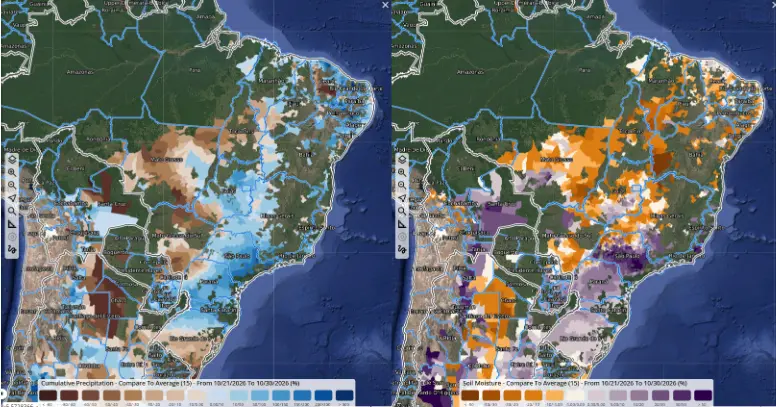
Rainfall (left) and soil moisture (right) compared with the long-term average, October 21 to 30, 2026. Southern Brazil was wet on both measures, while parts of Goiás and Minas Gerais received above-average rain but still had drier-than-average soils. Source: EarthDaily
Vegetation and biomass, tracked through the season, get closer still. They carry the combined effect of weather, soil, management, and pests on the crop's actual condition. That signal can also be weighted against the growth stages that decide yield and quality. Every step away from the plant adds basis risk.
The Indian Ocean Dipole is the reminder: it can push rainfall away from what the El Niño signal alone would suggest, so an index built on the ocean, or even on rainfall, can drift from the loss. An index tied to the vegetation itself drifts less.
None of this is free of trade-offs. A vegetation index needs consistent imagery, and El Niño cloud cover can blind an optical signal at exactly the growth stage that matters, which is why high revisit and radar backup belong in the design. Vegetation measures have to be back-tested like any other, and the strongest products often pair a vegetation index with a weather trigger rather than lean on either alone.
Once the season is underway, the bound contract does not change, but the same field-level observation is not idle. It shows where the book is likely to pay versus where the crop is actually failing, which updates expected loss and reserves, informs how much net risk to keep or cede, and feeds the observed basis error into next season's trigger design. The trigger remains the one that was sold. What the crop shows during the season is what makes next year's trigger better.
From Sovereign Cover to the Individual Farmer
The same design question repeats at every scale, from a single field to an entire country. Sovereign parametric insurance, bought by governments, is the largest version of it. Only 3.3% of Brazil's cultivated area was covered under the federal premium subsidy programme in 2025. When a strong El Niño hits a region that is uninsured, the crop failure becomes a government problem overnight, and the pressure to fund emergency relief starts immediately. This can strain state budgets and delay economic recovery.
Sovereign parametric insurance bypasses manual damage checks entirely. Instead, governments buy policies that automatically pay out a pre-agreed sum the moment an independent index, such as Pacific sea surface temperature reaching 2 degrees Celsius, a specific regional rainfall deficit or a specific loss of biomass, crosses a strict hazard threshold. This season, the sea surface temperature threshold has already been passed: NOAA's Niño 3.4 index stood 2.1°C above normal in early October. Sovereign cover replaces slow and unpredictable emergency aid with immediate, contractually guaranteed liquidity. This allows states to protect social safety nets and distribute cash directly to affected communities within days of an El Niño-caused agricultural disaster.
There is also microparametric insurance for individual farmers. The core value proposition is the same, with the same advantages: payouts bypass claims adjusters and arrive in the farmer's bank account within three to seven days of the event. This provides the rapid cash flow needed for buying seeds for the next planting cycle. There is very little administrative overhead, and it keeps premiums lower and more affordable for smallholder farmers.
Colombia shows how the two scales can meet. In August, the national government contracted five parametric policies on behalf of 14,402 smallholder farmers in five departments, worth up to US$20.14 million and developed with the IDF, UNDP and Germany's BMZ, ahead of this El Niño. Payouts are triggered by a satellite-derived water balance index at municipal level and can be paid directly into farmers' bank accounts or digital wallets.
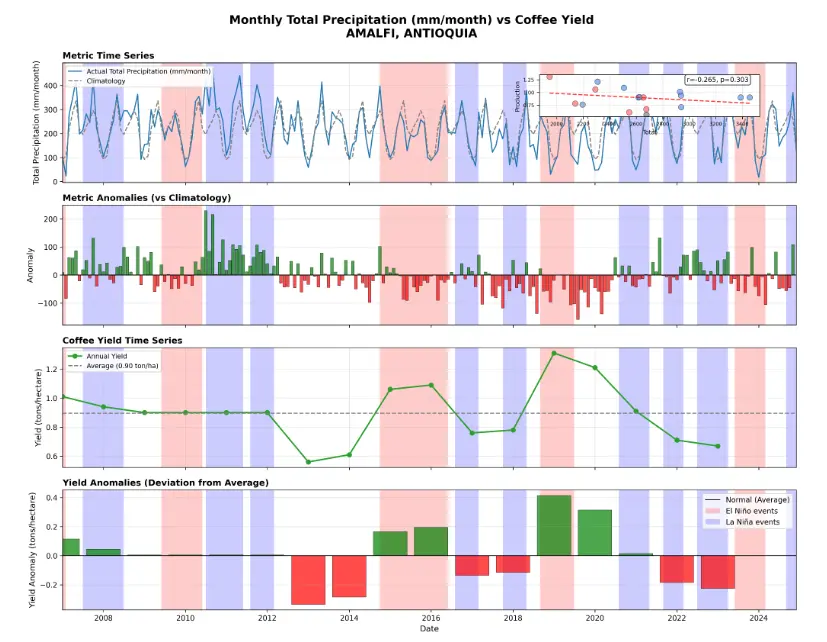 Monthly rainfall and annual coffee yield in Amalfi, Antioquia, Colombia, 2007 to 2024, with El Niño (red) and La Niña (blue) periods shaded. Annual rainfall shows only a weak relationship with production, and El Niño years did not consistently bring yield losses.
The main disadvantage is that the policy does not compensate for actual individual field losses. Farmers receive a fixed payout only if the index crosses the trigger set for it. If a unique microclimate ruins a specific field but the broader regional index is not triggered, the farmer receives nothing. It is the same basis risk described earlier, now playing out at the scale of a single field rather than a regional index.
Vegetation indices are increasingly used alongside weather here because they measure plant health and biomass directly, one step closer to the actual loss than rainfall or temperature, and at a much higher resolution. Multi-trigger products, which require more than one index to fire before they pay, combine parameters to mirror real field conditions, for example rainfall and temperature together, or soil moisture below a threshold for five days alongside low vegetation vigour.
The closer the trigger sits to the plant, the smaller the gap between what pays and what is lost