

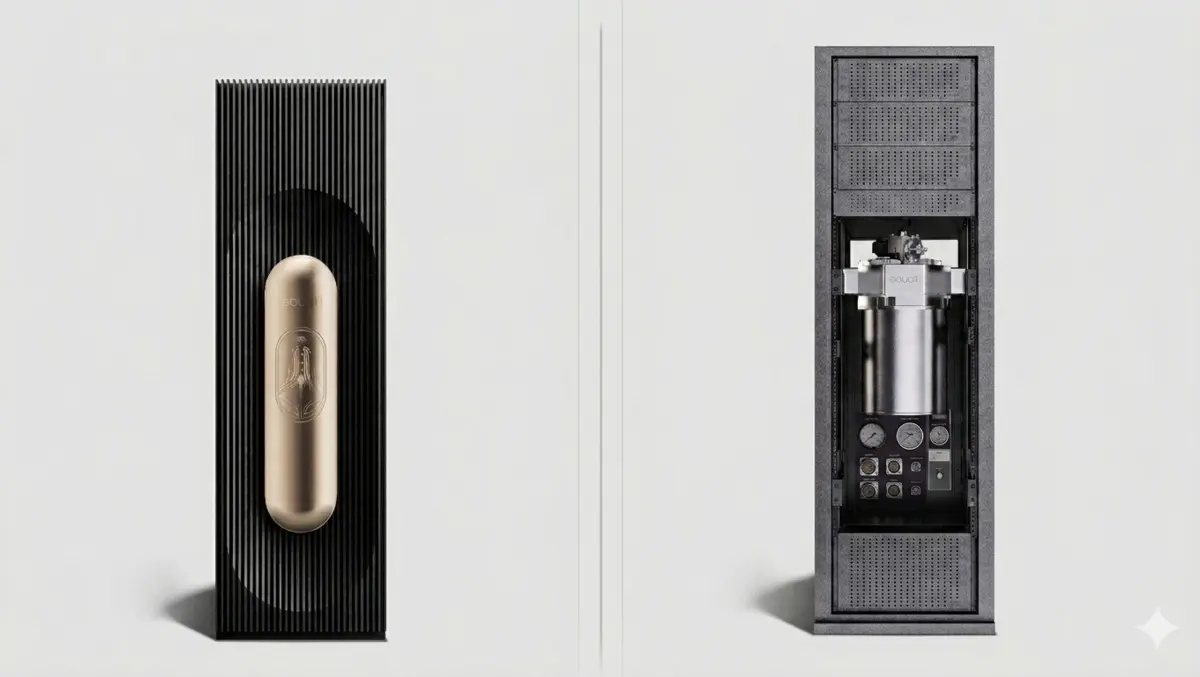
Equal1 launches rack-mounted quantum computer RacQ
Mon, 18th May 2026 (Today)
Equal1 has launched RacQ, a rack-mounted silicon-spin quantum computer designed for a standard 19-inch data centre rack. The system is intended to bring hybrid quantum-classical computing into existing data centre environments.
RacQ succeeds the company's Bell-1 system and is built to sit alongside conventional computing hardware in a familiar rack format. Equal1 describes it as a deployable hybrid quantum-classical machine that can be rolled into a data centre and connected using a standard 1.6kW power socket.
The launch coincides with a research collaboration with Dell examining how quantum and classical systems can operate together inside existing data centre infrastructure. In an experimental prototype, RacQ is integrated with a Dell PowerEdge R770 server, PowerSwitch networking equipment and Dell's Quantum Intelligent Orchestrator within a standard rack design.
Equal1 is aiming to address one of the longstanding barriers to wider quantum adoption: the need for specialist infrastructure. Quantum systems have typically been housed in bespoke environments, with cooling, power and integration requirements that make them difficult to place inside mainstream enterprise and research computing estates.
RacQ is designed to avoid some of those constraints. It uses a self-contained closed-cycle cryocooler that maintains an internal temperature of 0.3 Kelvin without external cryogenic infrastructure. The machine weighs 400kg and is sized to fit in a standard Dell 42U frame.
Hybrid approach
Equal1 is focusing on hybrid quantum-classical computing, in which classical and quantum workloads are combined within a single workflow. Under that model, selected subroutines are sent to the quantum processor while pre-processing and post-processing remain on classical servers.
The company says this approach could apply to investment risk analysis, materials simulation and supply chain optimisation. The aim is to let organisations test and run selected quantum workloads without rebuilding their computing environments around a stand-alone quantum system.
The hardware is powered by UnityQ, which Equal1 describes as its quantum system-on-chip. The design is based on standard CMOS semiconductor processes, a choice intended to align manufacturing with established chip production methods.
That link to conventional semiconductor processes is central to Equal1's pitch. Rather than positioning quantum hardware as a separate class of machine requiring a dedicated facility, the company argues that it can be treated more like another rack resource, sitting alongside servers and networking gear already used in data centres.
Data centre fit
The Dell collaboration remains at the research stage, but it offers a practical illustration of the deployment model Equal1 is pursuing. The prototype combines a quantum computer, a server, networking equipment and orchestration software in a single rack environment, with the goal of managing workloads across different types of compute resource.
For operators of high-performance computing environments, the question is less whether quantum hardware can exist in the same building as classical infrastructure and more whether it can integrate with minimal disruption. Equal1's design centres on reducing that disruption through standard power requirements, a contained cooling system and a conventional footprint.
Jason Lynch, chief executive officer of Equal1, set out the company's argument directly: "For nearly every organization, quantum computing remains out of reach, confined to labs. We're changing that. We are putting quantum inside the rack so customers can roll it in, plug it in and begin running hybrid quantum-classical workloads in days, using the infrastructure they already own."
The launch reflects a broader push across the quantum sector to move beyond laboratory systems and towards equipment that can be integrated into production computing environments. Many companies are still working through how quantum processors should connect to classical servers, scheduling systems and networking layers, especially for mixed workloads that rely on both forms of compute.
Equal1's contribution to that discussion is a system built as much around form factor and installation requirements as qubit design. By keeping power demand to around 1.6kW, incorporating its own cooling and fitting within a standard rack footprint, the company is trying to lower the practical barriers that have limited where quantum systems can be deployed.
The machine builds on Bell-1, the basis of the company's earlier work, while shifting the design into a format intended for direct use inside established data centre estates. Equal1 says RacQ is designed to integrate with any classical compute hardware and operate as a peer-level resource within the rack.
UnityQ, the silicon package at the centre of the system, is intended to integrate the complete quantum system onto a single package. Built using standard semiconductor processes, it runs from a single-phase electrical socket, while the wider system remains self-contained at 0.3 Kelvin and 400kg.