

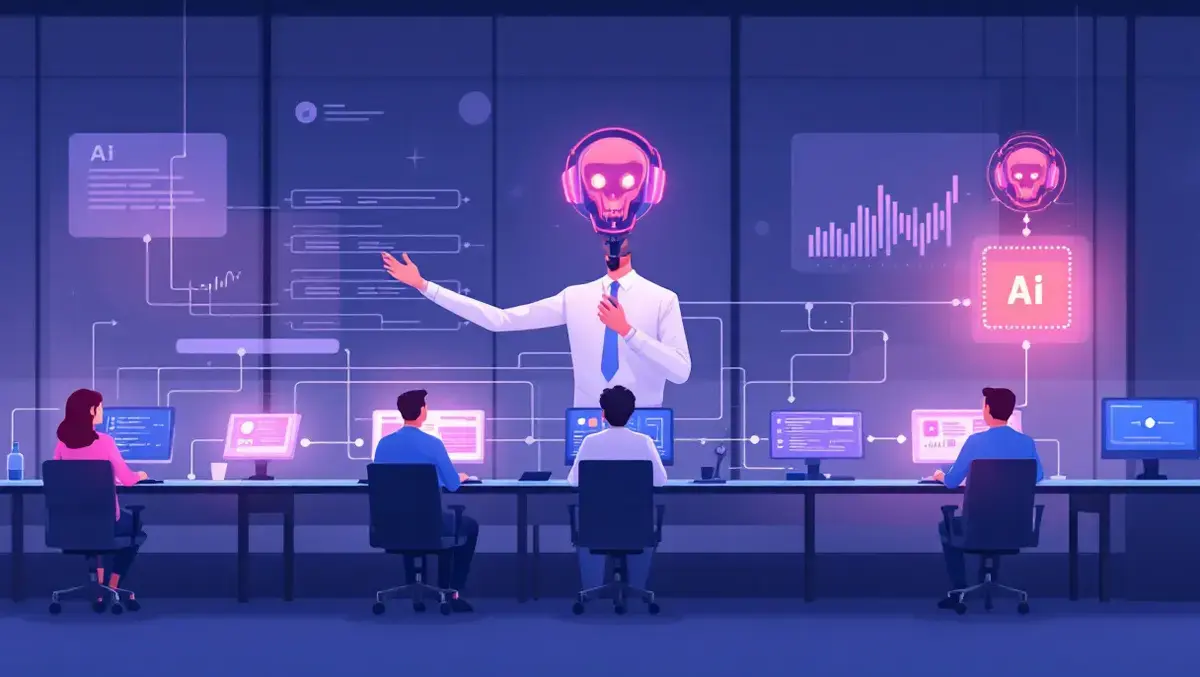
Google Cloud outlines five lessons for AI agent adoption
Tue, 17th Nov 2026 (Today)
Google Cloud has outlined five lessons for companies adopting AI agents in daily operations, drawing on Google Cloud Consulting's work with businesses introducing agent-based systems.
The guidance focuses less on software procurement and more on workplace design, accountability and management as companies move from generative AI tools that answer questions to systems that carry out tasks.
Businesses often start by adding an AI tool to an existing workflow, but that can leave bottlenecks in place. Google Cloud Consulting argues that organisations should redesign processes so agents handle routine work while staff set priorities and remain responsible for results.
That means moving away from models in which people validate each stage before passing work to the next colleague. Instead, Google Cloud advocates a "human-in-the-lead" approach, with agents executing tasks, including those with multiple dependencies, while staff step in only for ambiguous or high-judgement cases.
Trust and Roles
Employee trust is a central theme. Many workers remain uncertain about their role when agents take on day-to-day tasks, while others worry about responsibility when an agent makes an error.
The advice is to treat agents like junior colleagues: delegate tasks, define scope and check output. It also recommends setting clear boundaries around the decisions an agent can make without human approval.
For companies starting out, the consulting team suggests beginning with low-risk uses such as internal scheduling before moving into areas with greater financial or operational consequences. The aim is to build familiarity before expanding the technology's use.
Hybrid teams
The document also addresses managing mixed teams of people and agents. Companies should assess workflows at both task and tool level, using cross-functional input to decide where agents fit and which uses are practical.
Managers are urged to focus on outcomes and recognise employees who can oversee agent behaviour effectively. In this model, strong performance comes not only from completing tasks, but from auditing an agent's reasoning and spotting when its logic drifts from business goals.
The consulting group also argues that coaching will be necessary if staff are to shift towards more creative and decision-based work. That points to a management challenge beyond deployment, particularly in larger organisations where work is split across functions and approval chains.
Experimentation and Governance
Another lesson centres on what Google Cloud calls agentic literacy. Employees need to understand not just how to prompt an agent, but how to judge its output, especially because these systems do not always follow fixed rules and instead choose what appears to be the most likely path.
To build that understanding, the guidance recommends giving business teams access to safe testing environments rather than limiting experimentation to technical specialists. It also says failed projects can still be useful if they expose weaknesses such as poor data quality.
On governance, Google Cloud Consulting backs a hub-and-spoke structure. Under that model, a central team sets policy, ethical guardrails and approved tools, while business units adapt those tools to local needs and feed back what works.
The consulting arm uses an internal Agent Catalog to share low-code agents and related tools across teams. It also notes that companies do not necessarily need to build their own platform, and can instead rely on internal directories, existing product features or tailored deployments developed with technical teams.
People-first shift
The broader message is that adopting AI agents is as much an organisational change issue as a technical one. Budget, computing resources and tools can help start an agent programme, but lasting use depends on whether workers feel able to experiment and whether leaders explain what the shift means for jobs and accountability.
"Ultimately, the overarching goal is to build an organization where human ingenuity and agents support and amplify one another."