

Oracle's racers: AI removes the grind, increases focus
Mon, 26th Oct 2026 (Today)
A line doing the rounds has rapidly become a cliche: people want AI to do the laundry and the dishes so they can focus on writing and art. Overwrought and overused? Sure. But it's turning into a recurring theme, and for Oracle's sponsored high octane sports teams, the theme turned up attached to some of the fastest machines on land and water.
That's the takeaway from a panel with Oracle Red Bull Racing head of technical and performance projects Jack Harington and SailGP Group Technology Director Matt Lord, who set out how Oracle Cloud Infrastructure (OCI) crunches some rather staggering volumes of data, and how AI takes drudgery off engineers' plates.
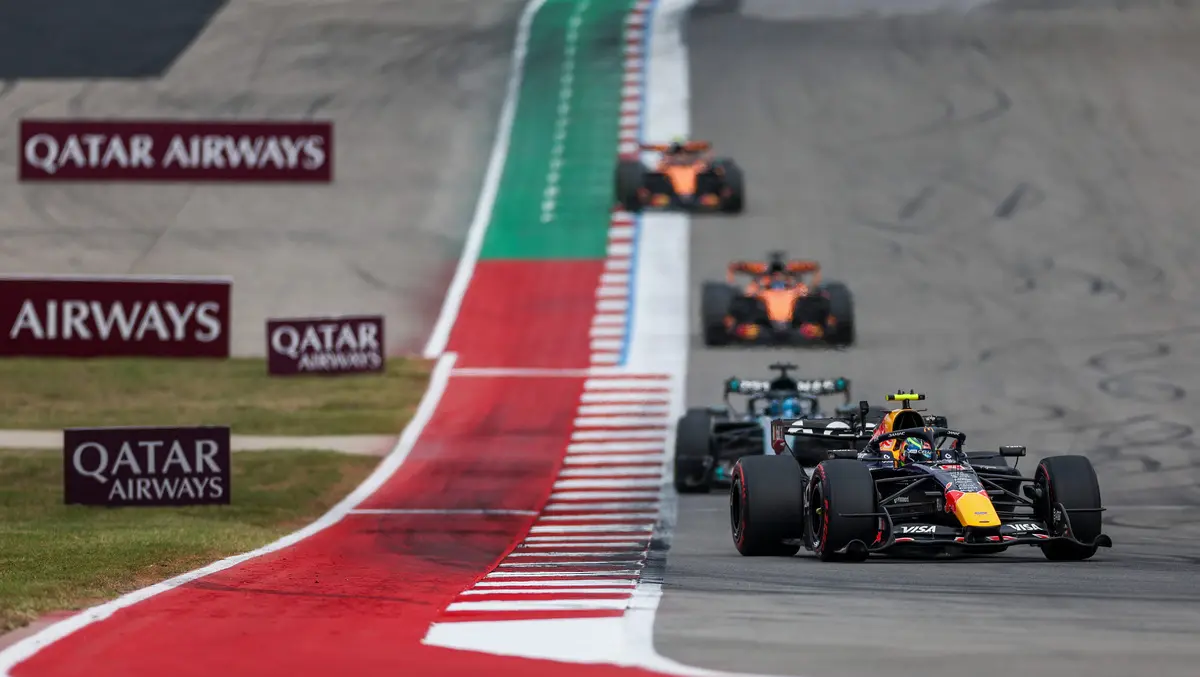
On the Formula 1 pit wall, the 'laundry' is the rulebook. Red Bull worked with Oracle to build an AI agent loaded with sporting and technical regulations and past decisions, which engineers can query mid-race. "Not only will it just search for the relevant regulation, but it will actually provide us a decision, and that decision can then be reviewed by our engineer on the pit wall and deployed live during the race," Harington explained.
That reflects the team's approach to AI, he said, "which is enabling our engineers to focus on what they're good at. And in a race, you don't want an engineer leafing through a document. You want them focusing on what Max [Verstappen] and Isack [Hadjar] are doing out on track."
Not, then, entirely dissimilar to how AI is being applied at work. It's an extension of the 'what sucks' meeting: think of what you don't like doing, then see if AI can do it for you.
Strip out the admin and there isn't much that sucks left. And there's plenty to strip: Accenture Research, interviewing 136 engineers and engineering leaders, found they spend roughly half their day on documentation, reporting and information search rather than core engineering work, costing an estimated US$39 billion a year globally. That's what sucks.
Eight billion ways to the chequered flag
Oracle has been Red Bull's title partner since 2021, and F1 is a data-hungry beast. "Formula One is a non-homologated sport, so we essentially get given a set of regulations, and we have to design, build, manufacture our cars, and they are quite incredible data-driven monsters and machines," Harington said.
The team pulls around two terabytes of data from the car every session.
The staggering bit is pit strategy, built on Monte Carlo simulations borrowed from finance and telecommunications. "Ahead of a race weekend, we're running eight billion Monte Carlo race simulations to try and plot the fastest way from the start to the finish of the race," he said. Another eight billion follow once practice data arrives, with models updated live during the race.
(For the uninitated, a A Monte Carlo simulation is a mathematical and computational technique that uses repeated random sampling to estimate the range of possible outcomes in a system with uncertainty.)
Moving those simulations to OCI lifted their number by 25%, Harington said, letting the team "play war games" against rivals' likely responses. "Since 2021, every winning decision that we've made as a strategy call has been made on OCI."
Nor does Red Bull see itself as merely a racing outfit. "A lot of people will look at us as being a Formula One team and some flashy cars that go racing around every track, but we are a technology company," Harington said.
Which is why it is also using generative AI and Oracle's Fusion applications to develop its people. "If we can develop an engineer to develop a better front wing by training the right way, then obviously that's going to lead to a faster car."
Sharing the data, not the secrets
SailGP plays it differently. The six-year-old league runs 13 teams in identical F50 catamarans which, Lord said, "Can do three times wind speed and reach speeds of 100 kilometres an hour without an engine."
He described the boats in unusual terms. "Our F50s are more like extreme IoT devices on water," Lord said.
Unlike F1, every team can see everyone else's data, the better to work out where marginal gains are found.
"You're much nicer than us," Harington quipped. "We protect our data very, very closely."
The SailGP league also owns the maintenance headache. "We built an anomaly detection program, which looks at all the sensor data coming off the boats, looks for any anomalies in it to understand is a component about to fail so we can fix or replace those parts before a boat hits the water," Lord explained.
Next is an AI agent to let onshore coaches ask questions of a chatbot, interrogating any speed differentials between boats and relating that back to actions taken, Lord said. An AI wind field map and real-time anomaly detection are also in the works.
Humans still in the loop
Could there be a whiff of hype? Gartner's 2026 Hype Cycle for Agentic AI places the technology at the Peak of Inflated Expectations, and its CIO survey found just 17% of organisations have deployed AI agents (more than 60% expect to within two years). Neither sport hands over the keys: Red Bull's agent recommends, and an engineer on the pit wall decides.
Be that as it may. But agentic AI is no longer confined to the lab; services like OpenClaw and more recently Grok Bot are demonstrating, from a consumer-upwards perspective, just how real and just how powerful the technology really is.
And with the laundry done, the dishes washed, and engineering admin consigned to the AI, it means more time invested on the jobs they're actually good at.