

Anthropic launches Claude Science for research teams
Thu, 2nd Jul 2026
Anthropic has launched Claude Science in public beta, a software app for scientific research teams built on the company's existing Claude models.
The app is available for macOS and Linux on Pro, Max, Team and Enterprise plans. Team and Enterprise access requires administrator approval. Anthropic is also offering a discounted Claude Team plan for research labs, prioritising academic and non-profit biomedical, basic science and hard science labs.
Claude Science is an application, not a new model. Its new element is a layer of scientific tools, database connections and compute integrations that lets users run analyses on their own infrastructure.
Anthropic is targeting researchers who want a single interface for data analysis, literature search and manuscript drafting. The company says the software can support work from data preparation to publication while keeping a record of the code, environment and conversation behind each output.
Research workflow
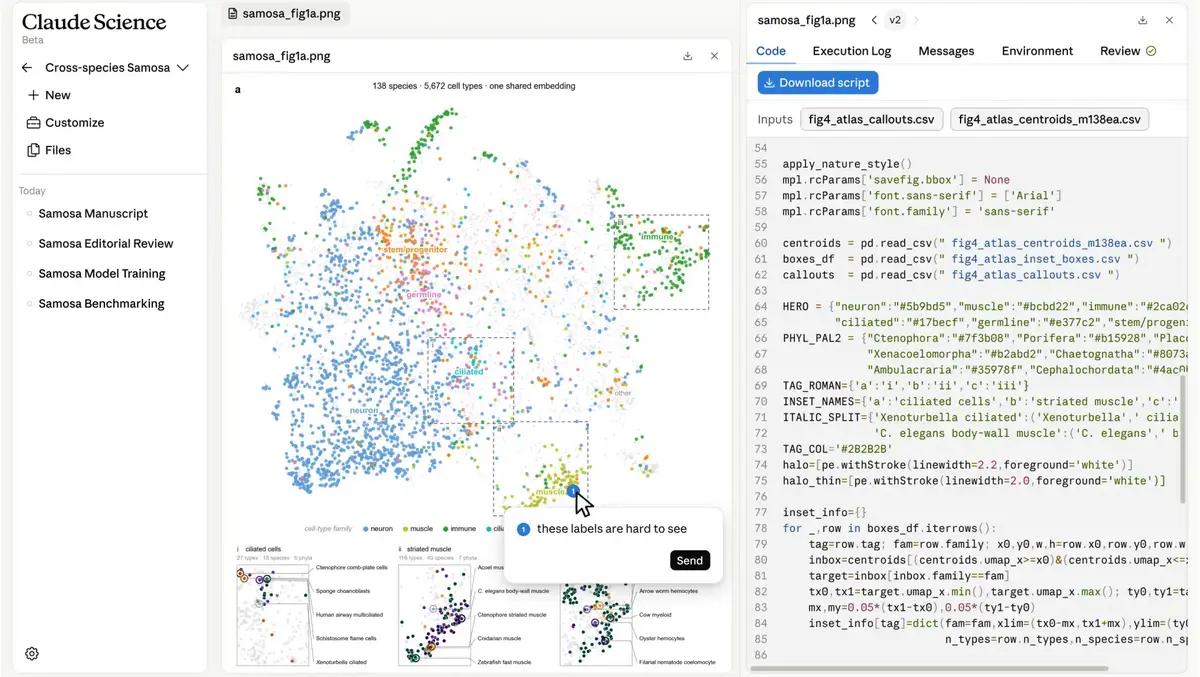
Figures, tables and notebooks created in the app include the exact code and environment used to generate them, according to Anthropic. The app also stores the conversation history tied to those outputs so they can be reproduced or edited later.
It includes built-in renderers for proteins, alignments, genomic tracks, chemical structures and PDF documents. Users can also annotate a figure in plain language to request edits, and the software will read the underlying code used to produce it.
A background reviewer checks citations, numbers and figures against supporting evidence before results are shown. Anthropic says this is meant to flag incorrect citations, untraceable numbers and figures that do not match their underlying code.
The app also supports manuscript drafting alongside analysis work, with rendered Markdown and LaTeX previews in the same workspace. The aim is to keep the research write-up close to the analysis that produced it.
Infrastructure links
The software is designed to run where research data already sits, including laptops, Linux machines, HPC login nodes and cloud virtual machines. Users connect through a browser, while jobs can run on local kernels, on Slurm clusters over SSH or through a Modal account.
Claude Science can build environments and manage compute resources ranging from a single GPU to hundreds, Anthropic says. It can write batch scripts, submit jobs and manage them across a user's own machine or cluster.
The app is designed to work with existing research software rather than replace specialist tools. Existing scripts in Python, R and shell can be read, run and extended, while internal systems and electronic lab notebooks can be linked through connectors.
Domain focus
Anthropic says Claude Science includes analysis specialists for genomics, single-cell work, proteomics, structural biology and cheminformatics, among other areas. The app can also query more than 60 scientific databases and connect to domain-specific open models.
The software uses skills in NVIDIA's BioNeMo Agent Toolkit to connect to life sciences models and libraries in BioNeMo, including Evo 2, Boltz-2 and OpenFold3. Anthropic says users can also save pipelines as reusable skills so future sessions inherit those workflows automatically.
Privacy is likely to be a central issue for research users handling sensitive data. Anthropic says the app runs on a customer's own infrastructure, with raw datasets and compute staying local, while content included in prompts and model responses is processed under its standard retention practices.
The launch adds to a growing market for AI tools aimed at specialist scientific work rather than general-purpose chat. Anthropic is positioning Claude Science as a workspace that connects research databases, compute resources and scientific software in one system, rather than as a standalone replacement for laboratory tools.
The app is also available on the Enterprise plan with SSO, SCIM provisioning, custom roles and usage analytics.