

Groundup.ai launches GINA V2 for industrial maintenance
Fri, 30th Oct 2026 (Today)
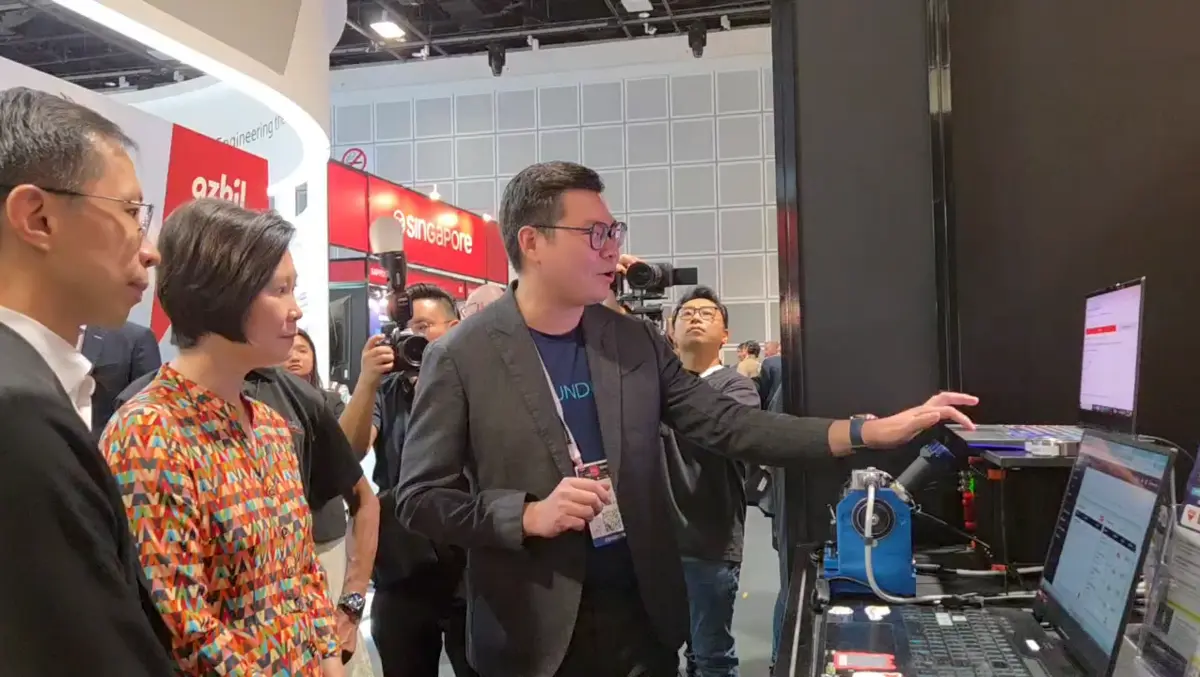
Groundup.ai has launched GINA V2, a new version of its industrial maintenance AI engine, at Industrial Transformation Asia-Pacific in Singapore.
GINA V2 is designed to identify machine faults and recommend corrective action by analysing sound, vibration and thermal data together. It aims to go beyond conventional predictive maintenance tools, which typically flag anomalies but leave plant operators to determine the likely cause.
The updated engine uses multimodal AI, signal processing and agentic reasoning to diagnose mechanical root causes. It assigns each machine a health score and presents its status through a traffic-light system to help operators decide which assets need immediate attention.
One of the main changes in the new release is a drivetrain visualisation feature that shows sensor placement and system-level views across multiple sites. Users can also compare sensor streams side by side, such as temperature and vibration, to identify patterns in equipment behaviour.
Another addition is a feedback loop that allows team input to refine the model over time. The system is also supported by Groundup.ai's asset library, which the company describes as a large industrial anomaly database designed to help the software interpret machinery data from the outset.
The release also includes enterprise features such as single sign-on, public API access, webhook support and additional language options. These changes are aimed at larger operations managing equipment across multiple locations.
Commercial push
The launch comes during what Groundup.ai described as its strongest commercial year so far. The company said it has secured eight-figure, multi-year contracts, expanded across Asia-Pacific, the Middle East and Europe, and won an open tender with PUB, Singapore's National Water Agency.
Groundup.ai said GINA V2 is already being deployed in manufacturing, maritime, defence and critical infrastructure. It also cited work with organisations including the Republic of Singapore Navy, Coca-Cola bottling operations and Anglo-Eastern.
Leon Lim, Chief Executive Officer and Founder of Groundup.ai, said the new release was intended to address a long-standing weakness in maintenance software.
"For years, maintenance software has been very good at raising its hand and saying something's wrong," Lim said. "That was never enough. The operator still had to work out what was failing, why, and what to do, often under pressure, on a machine that couldn't wait. GINA V2 is built to answer those questions. She never sleeps and never misses a signal. This is what Cognitive Maintenance was always meant to be: AI that reasons, diagnoses and guides, so the people keeping our factories, fleets and operations running are empowered to act with confidence."
Maintenance gap
Industrial operators have increasingly adopted predictive maintenance tools to reduce unplanned downtime and extend equipment life. Many of those systems rely on threshold monitoring and alerts based on changes in vibration, temperature or other operating signals, but they still often require engineers or technicians to interpret the problem and decide the next step.
Groundup.ai is positioning GINA V2 as a system that closes that gap by combining machine condition monitoring with diagnosis and recommended action. The company said its software architecture was built as an AI-native platform rather than adapted from older condition-monitoring systems.
The launch also underlines the growing use of AI in asset-heavy sectors, where operators are dealing with ageing machinery and increasing pressure on maintenance planning. In those industries, the value of software often depends on whether it can shorten the time between detecting a fault and making a repair decision.
Groundup.ai said its platform can be deployed on-premises or in the cloud and is focused on sectors with critical equipment fleets. The company added that its machine intelligence engine has been trained on millions of data points covering sound, vibration and thermal signals.
The latest release places the emphasis on direct operational guidance rather than dashboard-based monitoring alone, with machine health scores, comparative trend analysis and system-wide visibility among the main changes.