

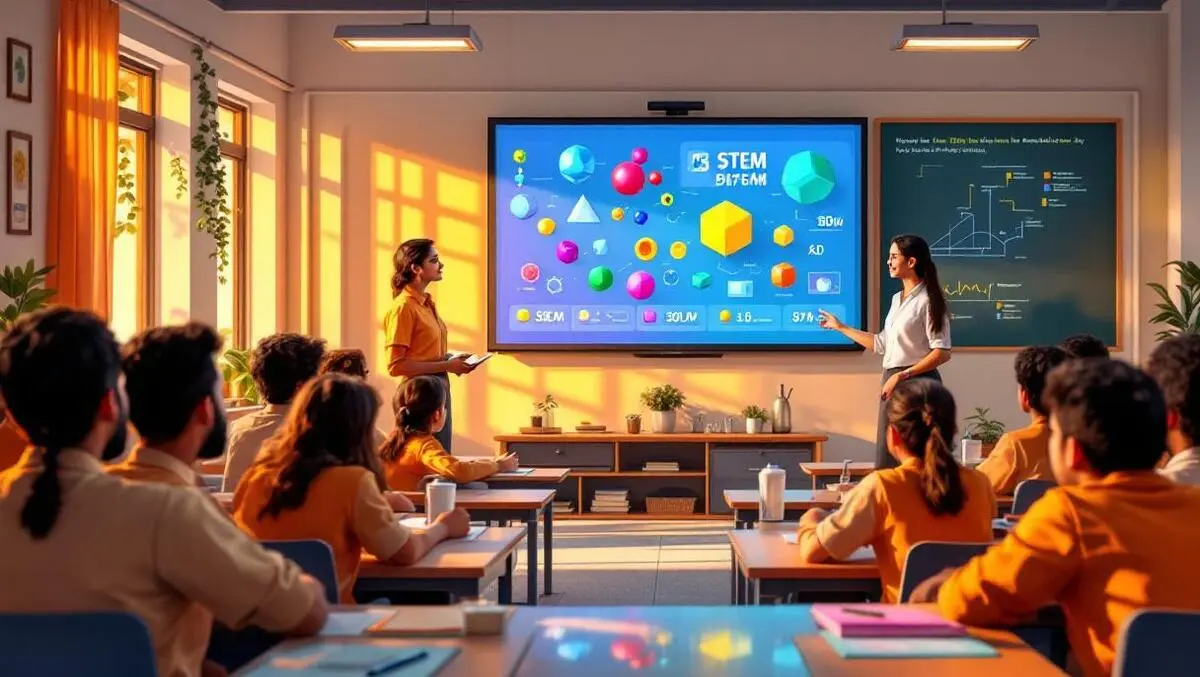
LOGIC & PhiBonacci bring 3D STEM labs to classrooms
Thu, 19th Mar 2026
Online Instruments has agreed a partnership between its LOGIC interactive display brand and edtech firm PhiBonacci that brings 3D STEM simulations to classroom screens sold to the education sector.
The arrangement integrates PhiBonacci's uniPhi myClass STEM software into LOGIC Interactive Displays as a native feature. The companies said the combined offer enables schools to use interactive 3D simulations without extra computing equipment.
Display integration
PhiBonacci, based in Ahmedabad, develops 3D and VR learning content. LOGIC is the interactive display brand of Bengaluru-based Online Instruments, which markets displays and audiovisual products for education, enterprise and retail settings.
The companies said digital STEM teaching often faces a constraint: many simulations are limited to two dimensions and rely on external devices for more complex rendering. In classrooms, that can add cost and complexity and introduce lag during lessons.
Under the partnership, PhiBonacci's library of more than 3,000 interactive simulations has been optimised for LOGIC's 4K interactive displays. The screens include 40-point multi-touch input, allowing multiple users to interact with content at the same time.
The offer is positioned as a bundle for schools. A LOGIC display installed in a classroom includes PhiBonacci's simulation ecosystem without separate installation of external computing add-ons, the companies said.
STEM use cases
PhiBonacci said uniPhi myClass is mapped to curriculum requirements and includes adaptable language interface support. It also cited a user base of more than 3 million students.
Classroom examples include anatomy demonstrations and physics models that respond in real time to teacher and pupil inputs. The companies said the approach can substitute for some physical lab activities and complement others, particularly where equipment, space, safety requirements or time constraints limit access.
Dr. Ravindra Dubey, Managing Director of PhiBonacci, said simulation-driven learning plays a different role in science and mathematics teaching than conventional lab work. "When it comes to mastering complex Science and Mathematics, interactive simulations transcend the limitations of traditional physical labs. They don't just show a concept; they empower students to truly experience it," Dubey said.
Dubey said the partnership removes technical barriers for teachers during lessons. "PhiBonacci provides curriculum-mapped simulation content with adaptable language interface support. By natively integrating our ecosystem, already proven and trusted by over 3 million students, we are completely removing technical barriers. Teachers can turn on the screen and instantly walk a class through a virtual heart dissection or a complex physics model with zero lag," he said.
Procurement focus
For school buyers, the companies positioned the integration as a standardised configuration that can be rolled out across classrooms. They said it reduces complex set-up steps and minimises variation in how lessons run from room to room.
Pankaj Bellad, Chief Business Officer at Online Instruments, said schools increasingly evaluate interactive displays as part of a broader learning software package rather than as standalone equipment. "This partnership marks a turning point in how we think about classroom learning," Bellad said.
Bellad described the screens as a central platform for lesson delivery, where software selection shapes day-to-day classroom use. "LOGIC was never just about the hardware. The real opportunity was always in what happens on that screen and integrating PhiBonacci makes that answer very clear. Every LOGIC display now functions as a fully equipped virtual lab, giving educators the tools to make even the most complex concepts genuinely click for students," he said.
The partnership is also aligned with India's National Education Policy 2020, which calls for experiential approaches to learning. The companies said simulation-led instruction can fit within that framework when schools need repeatable practical demonstrations in science and mathematics.
In a statement included with the announcement, Bellad said the project was built with large deployments in mind.
"What we've built here is designed for scale. Schools don't need to overhaul their infrastructure or navigate complicated setups, LOGIC handles that. The focus shifts entirely to learning outcomes: immediate academic impact in the short term, and a lasting digital capability that institutions can build on."
Online Instruments said all LOGIC Interactive Displays designed for the education sector will include PhiBonacci's uniPhi myClass STEM software as part of the native integration.