


Most firms using AI see little business value, survey
Thu, 30th Apr 2026
Research published by Appian found that most organisations using artificial intelligence have yet to realise significant business value from it. The survey covered 385 business decision-makers across North America, Europe and Asia-Pacific.
The study, conducted by Harvard Business Review Analytic Services and sponsored by Appian, found that 59% of organisations moving forward with AI to some extent already have it in production. However, the gains reported were concentrated in productivity and operational efficiency rather than revenue growth or return on investment.
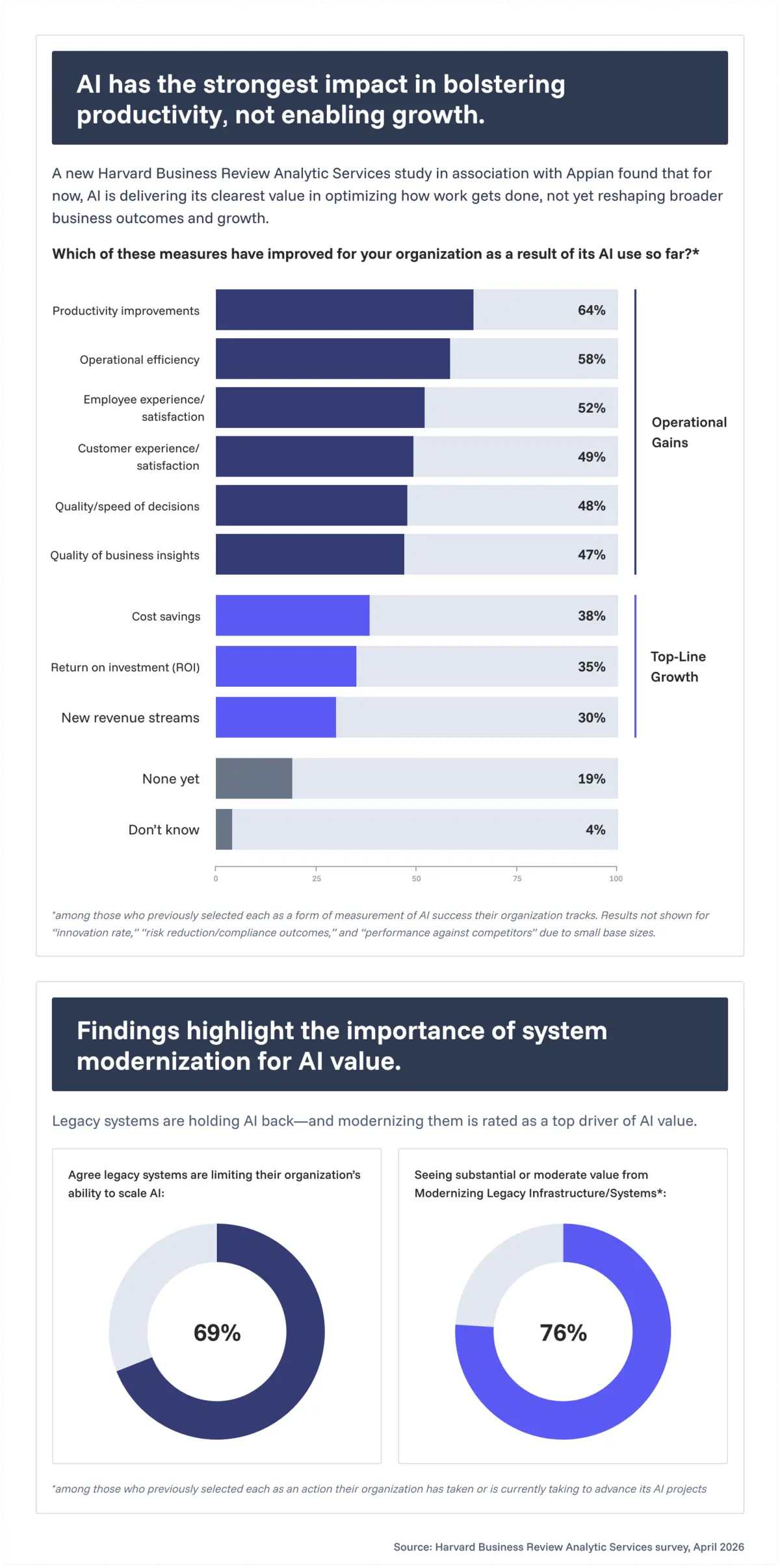
Among the performance measures organisations track, 64% said AI had improved productivity and 58% reported better operational efficiency. By contrast, only 35% reported improvements in ROI and 30% saw an effect on new revenue streams.
The findings suggest many companies have moved beyond early experimentation but remain at an intermediate stage of deployment, where AI is delivering limited operational benefits without reshaping core business performance. Most respondents said their organisations still expect more from their AI investments, with 86% agreeing they are seeking greater business value from the technology.
Workflow gap
A central theme in the research is how AI is used inside organisations. Only 18% of respondents said AI is primarily integrated into workflows, while 34% said it is used as a standalone tool alongside processes and another 34% reported a mix of both approaches. A further 12% said AI is not yet being used in processes or workflows at all.
That matters because the study found stronger results where AI is embedded directly into day-to-day operations. Seventy-one per cent of organisations embedding AI into processes said they had realised substantial or moderate value from those efforts.
Returns were also stronger among organisations that had taken steps to modernise supporting systems. About three-quarters of respondents reported solid returns from modernising legacy infrastructure and systems, integrating data sources, and orchestrating processes and workflows across systems and applications.
Legacy technology remains a major constraint. Sixty-nine per cent of respondents said legacy systems are limiting their ability to scale AI across the organisation. Other commonly cited barriers were siloed or poor-quality data, identified by 34%, lack of integration across systems at 31%, and a shortage of AI talent and skills at 30%.
Measured returns
Most organisations reported some level of benefit from AI, but few described the outcome as strong. Only 16% said they had realised a high degree of measurable value. Another 33% described the value as moderate, 36% as slight, and 8% said they had no measurable value at all.
These figures point to a broad pattern: spending and activity around AI remain high, but the business case is still uneven. Many organisations can point to isolated improvements, while fewer can show broad, scalable impact.
Appian chief executive Matt Calkins said the emphasis now needs to shift. "Enterprises are at an inflection point. Instead of using AI to drive productivity, organisations must evolve to focus on business growth. That's where Appian comes in," he said. "The true potential of AI can only be realised when it moves from a standalone tool to an embedded worker that drives revenue. To get there, leaders must prioritise the foundational orchestration and rules-based guardrails required to safely apply AI to high-impact work."
Agent adoption
The research also examined the use of AI agents, showing a clear divide between back-office and technical functions and more complex operational environments. Respondents said AI agents were most commonly deployed in software development at 35%, IT operations at 31%, marketing and sales at 26%, and customer service at 25%.
Use was far lower in procurement, where 9% reported adoption, manufacturing at 10%, and supply chain at 11%. According to the study, these areas tend to involve more complex processes and require tighter control and consistency.
Governance appears to be a concern as interest in agentic AI grows. The research found that 25% of organisations are already using agentic AI and 62% are considering it. At the same time, 92% of respondents agreed that AI agents need rules-based guardrails to operate safely and effectively, but only 48% of organisations using, considering or exploring agentic AI said they had defined such rules.
Respondents also pointed to process design as a growing priority for organisations seeking better outcomes from AI. Half said their organisations were focusing on better defining the rules and guardrails AI must follow, 49% cited standardising processes and workflows across functions, and 47% pointed to greater cross-functional coordination.
Alex Clemente, managing director of Harvard Business Review Analytic Services, said the issue is less about whether organisations are adopting AI and more about where it sits in their operations. "Organisations are adopting AI, but many haven't integrated it into the core processes that drive business outcomes," he said. "Those that successfully embed AI into workflows will be better positioned to realise meaningful value."