

QNu Labs signs quantum security deals with TU/e & SAGA
Thu, 18th Jun 2026 (Today)
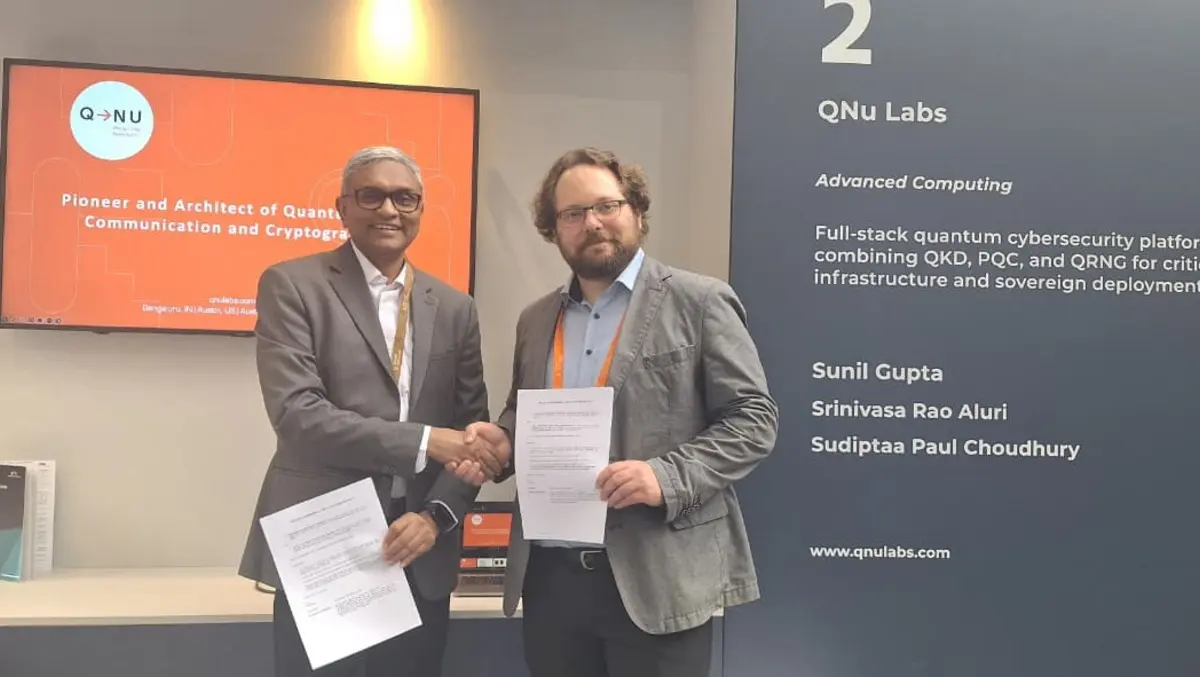
QNu Labs has signed a research collaboration with Eindhoven University of Technology and a strategic agreement with SAGA Consultants. The deals were announced as the Indian quantum cybersecurity company took part in Bharat Innovates 2026 in Nice.
The collaboration with the Dutch university focuses on quantum communication security, including the testing, validation and long-term resilience of Quantum Key Distribution systems. The work sits under the ACE QKD programme and is intended to address issues that must mature before quantum-safe infrastructure can be deployed at national scale.
At the same event, QNu Labs signed a separate agreement with SAGA Consultants focused on the banking and financial services sector. The arrangement is intended to support the adoption of quantum-safe security systems in BFSI.
QNu Labs was among 120 Indian deep-tech companies selected by the Indian and French governments to showcase technology at the event. It exhibited under the next-generation communications track and presented what it described as a hybrid quantum-safe network combining Quantum Key Distribution and post-quantum cryptography.
The company also demonstrated other parts of its security portfolio, including unified key life cycle management. The network on show is designed to protect communications against current and future cyber threats and to operate across national borders.
Research focus
Eindhoven University of Technology brings quantum networking research expertise to the partnership, while QNu Labs contributes experience from deployments in defence, banking, telecoms and critical infrastructure in India. The collaboration is intended to support research relevant to international quantum security standards.
Dr Simon Rommel, Assistant Professor, Eindhoven University of Technology, outlined the rationale for the partnership.
"Europe and India share a common interest in building quantum communication infrastructure that is sovereign, trusted and standards-compliant. This partnership with QNu Labs is a concrete step toward that shared goal and toward ensuring that QKD technology meets the rigour the world expects of it," said Rommel.
The agreement reflects growing international interest in securing communications against the threat posed by future quantum computers, which are expected to undermine widely used public-key encryption systems such as RSA and elliptic curve cryptography.
Industry push
Migration to quantum-safe infrastructure will take years rather than months for organisations that rely on these systems. QNu Labs has positioned itself around tools intended to support that transition.
Sunil Gupta, Co-Founder & Chief Executive Officer, QNu Labs, said the shift required a broader rethink of security architecture.
"Securing the future of digital infrastructure requires fundamentally new security architectures, not incremental upgrades. At QNu Labs, we are building and deploying quantum-safe technologies that protect nations, enterprises and critical infrastructure against threats from agentic AI, traditional cyber attacks and future quantum computers already on the horizon. Bharat Innovates gives us a platform to show the world that India is not just participating in the AI and quantum era, but leading it," said Gupta.
Another senior executive linked the university collaboration and the SAGA deal to a wider partnership strategy spanning academia, industry and the public sector.
"Quantum security cannot be built in isolation. It needs industry, government, defence and academia working from the same blueprint. Our collaboration with TU/e and our presence at Bharat Innovates reflect exactly that: building the global partnerships that make quantum-safe communications a reality, not just a roadmap item," said Choudhury.
Founded through incubation at IIT Madras, QNu Labs says it has spent a decade developing quantum cryptography and communication products in India. It is backed by the National Quantum Mission and says its systems are already in use across defence, banking, telecoms and critical infrastructure.
The company also has a US-based spin-off, enQase, which serves the American market as a separate entity. In Nice, its immediate focus was on using the international platform to present Indian-developed quantum security technology while extending research and commercial ties in Europe.